This is a project carried out for the Design Synthesis Exercise project of the BSc Aerospace Engineering at TU Delft, whose aim is to collaborate in groups of 10 students over a period of 10 weeks to make a design in an aerospace-related field. The project covers the complete design process, from drawing up a program of demands, concept analysis and design, concept selection to the presentation of the final design.
Read the full report
You can download the paper on the TU Delft repository here.
Check out the poster
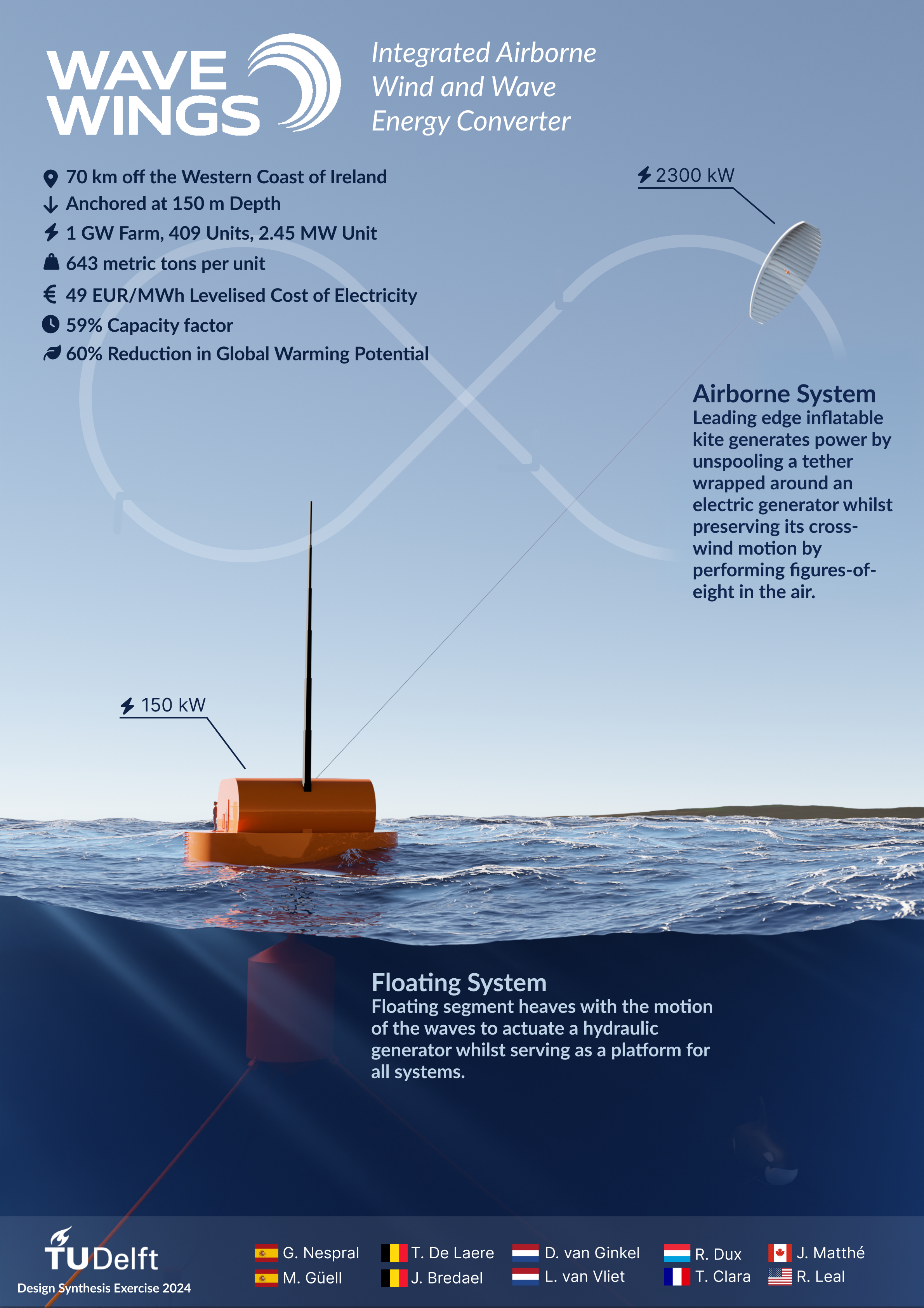
WaveWings aims to exploit the synergy between coupled airborne wind energy and wave energy devices in order to construct a 1 GW renewable energy farm in an effort to contribute to the European Union’s net-zero 2050 goals.
The design of the WaveWings system is performed at two levels: the farm level and the single unit level. The farm contains 400 individual units and the infrastructure, such as inter-array cabling and 5 offshore collection stations with multi-link high-voltage AC power transmission to the 5 onshore stations.
At the single unit level, which is the main focus of this project, the system consists of a buoy to which all the subsystems are attached. The airborne wind energy system (AWES) consists of a leading-edge inflatable (LEI) kite with a preliminary surface area of 450 m², connected to the buoy by a 1150 m long tether. The AWES can produce 2.3 MW of power with a preliminary capacity factor of 57%. The kite is launched and retrieved using a telescopic launch tower.
The wave energy converter (WEC) consists of the main buoy and a submergible buoy, making it a point absorber capable of generating 200 kW of rated power. Power take-off is achieved using a hydraulic system for both the AWES and the WEC. During the last phase of this project, the estimates of the technical parameters will be refined using appropriate simulations in an iterative design approach.
Choosing the west coast of Ireland as a potential site location, the Irish electricity market is the envisioned business environment. Based on a custom-developed economic model, several key financial indicators of the WaveWings system are estimated, including a levelized cost of electricity (LCOE) of 65 €/MWh. This is similar to that of conventional floating wind turbines, promising to be a viable contribution to the availability of renewable electricity in the Irish market.
Based on the United Nations Sustainable Development Goals, sustainability has been an important consideration for both the organizational and technical aspects. In particular, sustainability has played a major role during site selection of the wind farm. A life cycle assessment (LCA) has also been performed to estimate, among other sustainability indicators, the global warming potential (GWP).